A place to embrace and empower new ideas; to describe and define a learning organization; to explore and enrich future and change;
FIND InnoNuggets
Friday, July 22, 2022
INVENTING INNOVATIVE ENTERPRISES - STARTUPs, OPEN INNOVATION, INCUBATION, INVENTIONS
Wednesday, October 14, 2020
TRIZCON 2020 - My Abstract - Inventing Complex Intelligent Strategic Systems (CISS)
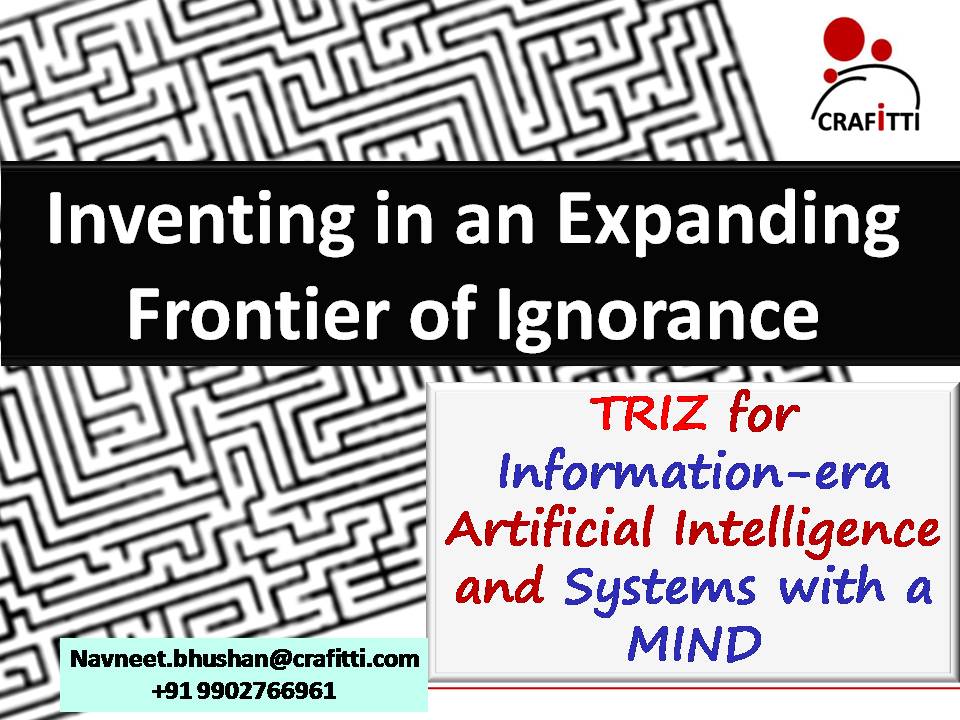
Inventing Complex, Intelligent, Strategic Systems (CISS) - ALVIS-SCAN thinking for the Sixth Wave of Innovation
Navneet Bhushan
We define a new class of systems and products named Complex Intelligent Strategic Systems (CISS). We propose that these systems are emerging in the Sixth Wave of Innovation (years 2015-2045). We evolve the formal definition of a system described in TRIZ and in Hubka’s Theory of Technical Systems, to include technical systems with a “mind” of their own. This also maps to the 10th Law of TRIZ proposed in 2012 – the Law of Increasing Intelligence of Technical Systems. The challenges of discovering, defining, describing, designing, developing, deploying, and deducing (7Ds) the CISS require a complete relook of their lifecycle. Besides the advent of cyber-physical systems, increasing intelligence of technical systems, the massive scale of these systems coupled with strategic nature of many of these systems leads to unprecedented challenges.
These systems are characterized by substantial decentralization, higher embedded/ambient algorithmic intelligence, inherently conflicting, unknowable and diverse needs/requirements, continuous evolution/deployment/learning, heterogeneous, inconsistent, and changing elements, erosion of people/system boundary, regular failures and new paradigms regeneration of parts of the system. Key aspects for 7Ds of CISS lifecycle i.e., Value, Inventiveness, Human Interaction, Computational Emergence, multi-level Design, Computational Engineering, Adaptive System Infrastructure, Adaptable and Predictable System Quality, Policy, Acquisition and Management are explained. Nine thinking dimensions proposed for CISS are Analytical, Logical, Value, Inventive, and Systems thinking (ALVIS) and Scale, Computational, Algorithmic and Network (SCAN) thinking. These thinking dimensions need to play a much larger part in an integrated manner than the current mostly analytical, logical and analogical thinking. We describe few case studies in ALVIS-SCAN thinking and describe ALVIS-SCAN thinking framework for 7Ds of CISS.
The TRIZCON 2020 was held online - a Virtual conference. The abstracts of all talks are published at AITRIZ site
https://www.aitriz.org/trizcon2020/abstracts-papers
Some Slides from my presentation
System Classification Framework
Complex Intelligent Strategic Systems
Law of Increasing Intelligence of Technical Systems
Function Model for CISS (Sixth wave of Innovation )
Tuesday, April 24, 2018
Sunday, January 01, 2017
Typology of Problems - Problem Formulation Framework
We describe 4 Types of Problems that we encountered usually in our workshops. Theory of Inventive Problem Solving (TRIZ) describe these as contradictions - some sort of conflicts between various system parameters.
Type A: Wish/Aspiration ~ Administrative Contradiction ~ May be High level Objective setting (Almost ~ Do "Something")
Type B: Unexpected Results/Consequences of an action
Type C: Beyond Optimisation (Technical Contradiction)
Type D: Paradox (physical contradiction)
-----------------------------------------------------
We describe below the basic anatomy of these 4 type of problems and what questions can help you refine these problem statements towards a solution thinking.
This is part of our SOUL-ALVIS-CRAFT framework
Type A: Wish/Aspiration ~ Administrative Contradiction ~ May be High level Objective setting (Almost ~ Do "Something")
Anatomy of Type A problems : (1) We should do X (increase productivity, profit, reliability, etc, decrease attrition, waste, etc)) (2) I want to do X, but have no opportunity or not allowed to do X. (3) We should do X, but do not know how/vague idea of how to do
Question on the problem statement : Why should you do X? What is stopping you to do X?
------------------------------------------------------
Type B: Unexpected Results/Consequences of an action
Anatomy of Type B problems : (1) We did Y expecting X, but it resulted in Z? (2) We did Y to do X, we achieved X partially but we also had Z which is harmful/not expected/not thought through?
Question on the problem statement : Why were you expecting X (X only)? What was missed out when you conceived Y to achieve X? Why Z was not expected? Could something done while doing Y caused Z? Can Y be modified to eliminate that something?
--------------------------------------------------------
Type C: Beyond Optimisation
Anatomy of Type C problems : (1) We improve X by doing Y but it worsen/reduce Z which is not desired. (2) We improve X by doing Y but we can not do more Y to improve X as it reduces/worsens Z, so we do Y only to an extent to optimise X and Z.
Question on the problem statement : Could something done while doing Y caused Z to worsen? What is that? Can Y be modified to eliminate that something? Can we find Y-Dash which does X AND doesn’t worsen Z?
---------------------------------------------------------
Type D: Paradox (physical contradiction)
Anatomy of Type D problems : (1) We want X to have P AND we want X to have "Not P". (2) We want X to function as Y AND we want X to function as NOT Y
Question on the problem statement : When do you want P and when not P? Where do you want P and where not P? Under what conditions you want P and under what conditions you want not P?
*****
Tuesday, April 12, 2016
Wednesday, April 06, 2016
Tuesday, March 29, 2016
Event: TRIZ Trends 2016 - at GE John F. Welch Technology Center, Bangalore, INDIA, Tuesday – April 12, 2016.
If you can make it kindly register quickly. Registration is FREE however seats are limited and time is by 31st March.
Kindly register early if you are in Bangalore on that day. KINDLY FORWARD THIS TO YOUR CONTACTS WHO MAY BE INTERESTED.
"Participation & Registration : Participation is open to Engineers, Scientists, Academicians, Researchers and others interested in practicing and applying TRIZ for Innovation in their respective disciplines on a first-come-first-serve basis limited to a maximum of 50 participants. Preference will be given to those who have a background in TRIZ through formal or informal learning / training / certification.
REGISTRATION IS FREE BUT MANDATORY.
To Register please send an email to mt.shyamsunder@ge.com with subject as “TRIZ-TRENDS 2016 Registration” and provide details of Name, Designation, Organization, City, Email ID, Phone and TRIZ relevant certification and experience.
LAST DATE TO REGISTER : March 31, 2016