In 1936 Enrico fermi wrote a book titled Thermodynamics - I bought the book - the unabridged Dover edition 1956 in 2001.
I recently opened it to read and liked it very much!
Fermi states in the preface
" Thermodynamics is mainly concerned with the transformations of heat into mechanical work and the opposite transformations of mechanical work into heat". Only in recent times have physicists recognized that heat is a form of energy that can be changed into other forms of energy.
He further states," ... The study of heat must be considered as a special branch of mechanics: the mechanics of an ensemble of such an enormous number of particles (atoms or molecules) that the detailed description of the state and the motion loses importance and only average properties of large number of particles can be considered. This branch of mechanics called statistical mechanics which has been developed mainly through the work of Maxwell, Boltzmann, and Gibbs, has led to a very satisfactory understanding of the fundamental thermodynamical laws."
Can this be the way to look at the new fields of large Networks and large complex systems?
My Book on Strategic Decision Making
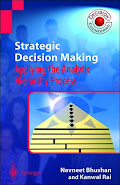
Applying the Analytic Hierarchy Process
Tuesday, August 05, 2008


Rating Systems
How do we rate things?
Supposing you are asked to rate something (say a book, movie, product, anything) on a scale of 1 to 5. What happens to your mind?
Do you really look at the scale? Do you really look at the product or item alone? Do you benchmark it with something that you already have seen? Does the rating change with time - meaning say in 1999 you rated a book as 2/5 but in 2004 when you read the book - your rating actually changed to 4/5 of the same book) as now you have grown 5 years become more aware and may be understand the book better? Based on your past behavior of rating things, can it be predicted with sufficient accuracy that if you get a new item, your rating will be say 3?
Fooled by Randomness author may say that this prediction, forecasting based on past ratings actually is big fraud? it is beyond anything that we know... yet we have systems that want to achieve this?
Supposing you are asked to rate something (say a book, movie, product, anything) on a scale of 1 to 5. What happens to your mind?
Do you really look at the scale? Do you really look at the product or item alone? Do you benchmark it with something that you already have seen? Does the rating change with time - meaning say in 1999 you rated a book as 2/5 but in 2004 when you read the book - your rating actually changed to 4/5 of the same book) as now you have grown 5 years become more aware and may be understand the book better? Based on your past behavior of rating things, can it be predicted with sufficient accuracy that if you get a new item, your rating will be say 3?
Fooled by Randomness author may say that this prediction, forecasting based on past ratings actually is big fraud? it is beyond anything that we know... yet we have systems that want to achieve this?
Subscribe to:
Posts (Atom)